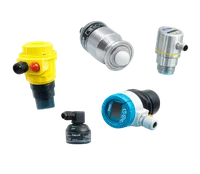
The 80 GHz radar level sensor is engineered for accurate and reliable liquid level measurement in industrial environments. Using advanced high-frequency radar technology, it delivers millimetre-level precision for measuring liquids up to 10 metres. Its non-contact operation ensures long-term stability without mechanical wear, making it an ideal solution for modern process automation systems.
Key Features
This radar-based level measurement system operates at 80 GHz, providing superior signal focus and accuracy. It enables precise measurement even in challenging conditions such as steam, condensation, or fluctuating temperatures. The sensor supports measurement through non-metallic materials, allowing installation on plastic tanks like IBC containers. Its maintenance-free design reduces operational costs while ensuring consistent performance.
Application
The sensor is widely used in industrial liquid storage tanks, chemical processing units, water treatment facilities, and food-grade applications. It is particularly effective in environments where traditional contact sensors fail due to buildup, corrosion, or wear. It is also suitable for open tanks, silos, and containers with varying geometries.
Design & Functionality
The compact design allows flexible installation on both closed and open tanks. With optional antenna extensions, it can be adapted for different mounting conditions. The radar system provides direct and continuous level measurement without blind zones. Integration with IT systems enables remote configuration, monitoring, and diagnostics, improving process control.
Total Crossed Beams
The focused radar beam ensures minimal signal interference and precise targeting of the liquid surface. This enhances measurement reliability even in narrow or complex tank structures.
Beam Pitch Options
Optimized beam angle ensures accurate readings across different tank sizes and shapes. The sensor adapts to varying installation heights while maintaining measurement consistency.
Intrinsic Synchronism
Advanced signal processing ensures stable readings in dynamic environments. The system maintains synchronization even with fluctuating process conditions, ensuring reliable data output.
Operational Advantages
This level sensor eliminates issues related to mechanical wear, deposits, or contamination. It offers easy installation, minimal maintenance, and long service life. With high precision and robust performance, it enhances efficiency, reduces downtime, and supports digital industrial automation.