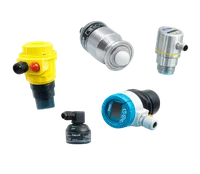
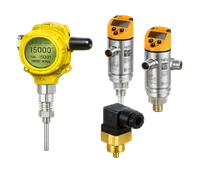
The capacitive non-contact level measurement sensor offers advanced external monitoring of liquid and bulk material levels without direct exposure to the medium. Designed for industrial applications, it ensures reliable performance through non-conductive tank walls, eliminating wear, contamination, and maintenance requirements. This innovative solution enhances operational safety and process efficiency across multiple industries.
Key Features
- Continuous level monitoring from outside the tank
- Non-contact detection prevents medium-related stress
- Integrated three-point level sensing in one unit
- IO-Link enabled for smart communication and control
- Real-time LED display showing level status
- Build-up detection with alert signaling
- Adjustable sensitivity for various media types
Application
This sensor is widely used in industrial tanks, storage systems, and processing units where direct contact measurement is not feasible. It is suitable for detecting liquids like water, acids, and oils, as well as bulk materials such as granulates. It plays a critical role in chemical processing, food production, material handling, and automated manufacturing environments.
Design & Functionality
The sensor operates using capacitive technology, allowing it to detect level changes through non-conductive materials such as plastic or glass. It continuously transmits process values ranging from 0 to 100% over a defined sensing range. With no dead band, it ensures precise measurement across the entire detection area.
The integrated LED display provides instant visual feedback, while IO-Link communication enables advanced diagnostics, parameterization, and system integration.
Total Crossed Beams
The sensor combines multiple sensing points within a single compact unit, enabling accurate level tracking across the entire measurement range without requiring multiple devices.
Beam Pitch Options
Its configurable sensitivity allows detection of both conductive and non-conductive media. Detection zones can also be suppressed to focus only on specific viewing areas such as sight glasses.
Intrinsic Synchronism
The sensor ensures stable and synchronized measurement output, minimizing interference and maintaining consistent performance even in dynamic industrial environments.
Operational Advantages
- Eliminates maintenance due to non-contact operation
- Prevents contamination and wear
- Detects build-up and signals maintenance needs
- Reduces downtime with real-time monitoring
- Supports smart factory integration via IO-Link