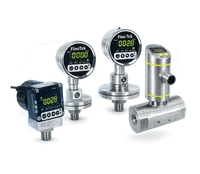
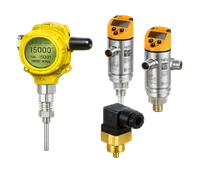
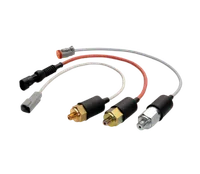
Flush temperature sensors for food industry applications are engineered to deliver precise and hygienic temperature measurement in critical processing environments. Designed for seamless integration into food and beverage systems, these sensors support accurate monitoring while maintaining strict hygiene standards. Their compact footprint makes them ideal for installations where space is limited, such as agitators and pigging systems.
Key Features
These flush-mounted sensors feature a robust stainless steel housing that ensures durability and resistance to harsh cleaning processes. The hygienic design prevents residue buildup, making them suitable for clean-in-place (CIP) and washdown environments. With options for 4–20 mA transmitter output or Pt100 sensing elements, they provide flexible integration into industrial control systems.
Application
Commonly used in food processing plants, beverage production lines, and sanitary pipelines, these sensors are ideal for applications requiring contamination-free temperature monitoring. They perform efficiently in mixing systems, filling lines, and pigging operations where hygiene and accuracy are critical.
Design & Functionality
The flush-front design ensures that the sensor integrates smoothly into the process without protrusions, reducing contamination risks. The G 1/2 sealing cone allows for secure and leak-proof installation across standard process connections. This design ensures safe sealing and long-term operational stability.
Total Crossed Beams
Optimized sensing elements ensure consistent temperature detection across the process medium, enhancing measurement reliability.
Beam Pitch Options
Engineered with precise sensing geometry, these sensors maintain uniform response across varying temperature ranges.
Intrinsic Synchronism
The sensors operate with high internal synchronization, ensuring fast and accurate response times even in dynamic environments.
Operational Advantages
With high protection ratings, these sensors withstand frequent cleaning cycles and harsh conditions. Their compact design enables installation in tight spaces, while their high accuracy improves process efficiency and product quality. These features make them essential components in modern hygienic manufacturing systems.