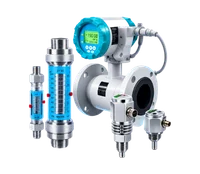
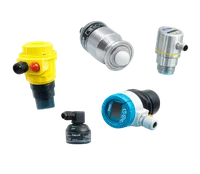
Guided radar level sensors based on Time Domain Reflectometry (TDR) technology provide highly accurate and reliable liquid level monitoring in industrial storage tanks and process vessels. These sensors transmit electromagnetic pulses along a probe and analyze the reflected signals to determine the exact liquid level. This advanced sensing method ensures precise measurements even in challenging environments where traditional level measurement technologies may struggle.
These sensors are widely used in industries such as water treatment, chemical processing, power generation, food production, and environmental monitoring. With the ability to measure liquids including oil, water, and viscous fluids, guided radar level sensors provide consistent and dependable process monitoring across various industrial applications.
Key Features
- Continuous liquid level monitoring using advanced radar pulse technology
- High measurement accuracy up to ±3 mm for reliable process control
- Stable operation in harsh industrial environments
- Integrated switching output combined with continuous measurement
- Strong anti-interference and antistatic protection
- Compatible with HART communication protocol
- Suitable for liquids with low dielectric constants such as hydrocarbons
- Compact design enabling flexible tank installation
Design & Functionality
The guided radar sensor operates by transmitting high-frequency electromagnetic pulses through a probe inserted into the tank. When the signal reaches the surface of the liquid, a portion of the energy reflects back to the sensor. The system calculates the liquid level by analyzing the time difference between the transmitted and reflected signals.
This measurement technique ensures accurate level detection even in difficult tank geometries, narrow nozzles, and small storage tanks. Unlike ultrasonic or traditional radar systems, guided radar sensors maintain reliable measurements close to the top and bottom areas of the tank.
The robust housing and stainless-steel probe ensure long-term durability in demanding industrial environments while maintaining high signal stability.
Total Crossed Beams
The advanced signal processing algorithm allows the sensor to filter disturbances and maintain measurement stability even when external interference or structural obstacles are present inside the tank. This improves detection accuracy and ensures consistent performance across different applications.
Beam Pitch Options
Different probe configurations and lengths allow the sensor to adapt to various tank sizes and process requirements. Single rod probes can reach lengths up to 3000 mm, while coaxial probe options can extend up to 6000 mm, providing flexibility for diverse industrial installations.
Intrinsic Synchronism
The integrated electronics provide synchronized signal processing and advanced disturbance suppression. This ensures that reflections from agitators, tank walls, or internal structures do not affect the measurement reliability.
Operational Advantages
Guided radar level sensors deliver several operational advantages for industrial facilities:
- Highly accurate continuous level measurement
- Reliable performance in complex tank environments
- Minimal installation restrictions
- Cost-efficient combination of switching and measurement functions
- Reduced maintenance requirements
- Improved process safety and operational efficiency
These benefits make guided radar sensors an ideal solution for industries requiring stable and precise liquid level monitoring.