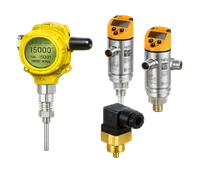
Thermowells are critical components used in industrial temperature measurement systems, designed to protect sensors from extreme operating conditions. In environments involving aggressive media, high pressure, and rapid flow rates, direct exposure can damage sensors and disrupt operations. Thermowells act as a protective barrier, ensuring process continuity while maintaining measurement accuracy. Their ability to allow sensor replacement during operation makes them indispensable in modern manufacturing and hygienic applications.
Key Features
These thermowells are engineered for durability and versatility. They support temperature probes with diameters starting from Ø 3 mm and offer installation depths ranging from 30 mm to 330 mm. The robust housing ensures resistance against corrosion, pressure, and mechanical stress. Additionally, their design enables calibration and maintenance without shutting down the process, reducing downtime and improving operational efficiency.
Application
Thermowells are widely used in industries such as food processing, pharmaceuticals, chemical manufacturing, and water treatment. Hygienic versions are specifically designed to meet strict sanitary standards, ensuring safe usage in contamination-sensitive environments. Industrial variants are ideal for pipelines, tanks, and reactors where reliable temperature monitoring is crucial.
Design & Functionality
The compact and sturdy construction of thermowells ensures long-term performance even in challenging conditions. They provide a sealed barrier between the process medium and the sensor, preventing direct exposure to harmful elements. Available in multiple process connection types, they offer flexible integration into various systems.
Total Crossed Beams
The structural integrity of thermowells ensures uniform protection across the sensing element, maintaining stability under fluctuating process conditions.
Beam Pitch Options
Flexible length and insertion depth options allow customization based on system requirements, ensuring optimal sensor positioning.
Intrinsic Synchronism
Thermowells maintain consistent thermal conductivity, ensuring accurate and synchronized temperature readings across processes.
Operational Advantages
By enabling sensor replacement without halting operations, thermowells significantly reduce maintenance downtime. Their resistance to corrosion and pressure enhances system reliability, while their compatibility with hygienic applications ensures compliance with industry standards. These advantages make thermowells a preferred choice for industries seeking efficient and safe temperature monitoring solutions.