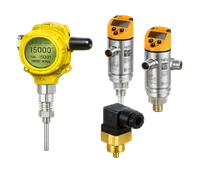
Infrared temperature sensors with display are advanced non-contact measurement devices engineered for high-temperature industrial applications. Designed to accurately detect thermal radiation, these sensors provide reliable temperature monitoring without physical contact, making them ideal for environments where traditional sensors fail. Industries such as steel manufacturing, glass processing, and heavy industrial production rely on these sensors for safe and precise heat detection.
Key Features
These sensors are equipped with dual independent switching outputs, allowing flexible control and automation. Their intuitive interface with integrated display ensures easy programming and real-time monitoring. The scratch-resistant precision lens minimizes interference from scattered light, ensuring consistent measurement accuracy even in challenging conditions. A built-in test function enhances operational verification either locally or through external signals.
Application
Infrared temperature sensors are widely used in high-temperature industrial sectors such as steel plants, glass furnaces, forging units, and heat treatment facilities. They are ideal for monitoring moving or stationary objects where direct contact measurement is not possible. These sensors help maintain process stability, improve product quality, and reduce the risk of overheating or equipment damage.
Design & Functionality
The sensors operate by detecting infrared radiation emitted by objects and converting it into an electrical signal. When the measured temperature exceeds a predefined threshold, switching outputs activate and LED indicators display the status. The integrated display continuously shows real-time temperature values, enabling operators to monitor conditions instantly.
Total Crossed Beams
The sensing technology ensures reliable detection of thermal radiation even in environments with fluctuating heat sources. This guarantees stable measurement performance across varying industrial conditions.
Beam Pitch Options
Optimized optical alignment and precision lens design ensure focused detection zones, reducing measurement errors caused by ambient interference or scattered light.
Intrinsic Synchronism
Advanced internal synchronization ensures accurate signal processing, enabling consistent performance even in fast-changing thermal environments.
Operational Advantages
With a robust housing and high-quality materials, these sensors withstand harsh industrial conditions including high temperatures, dust, and mechanical stress. Their non-contact measurement capability enhances safety, reduces maintenance, and improves operational efficiency. Easy configuration and reliable output make them a critical component in modern industrial automation systems.