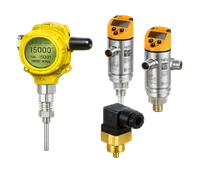
The intuitive switch point setting sensor is engineered for reliable and precise temperature control in industrial environments. Built with user-friendly adjustment mechanisms and fast response capabilities, it offers an efficient solution for monitoring and regulating temperature-sensitive processes. Its compact design and robust construction make it ideal for integration into modern automation systems where accuracy and reliability are essential.
Key Features
- Dual radial setting rings for precise and easy adjustment
- Fast response time for real-time thermal monitoring
- Mechanical locking system prevents unintended changes
- Wide adjustable temperature range from -25 °C to 140 °C
- Setup without requiring active system temperature
- Compact and durable housing for industrial use
Application
This temperature sensor is widely used across industries such as manufacturing, HVAC systems, process automation, and machinery protection. It ensures stable operation by maintaining defined temperature thresholds, preventing overheating, and reducing system downtime. It is especially effective in applications where manual adjustment and reliability are critical.
Design & Functionality
The sensor features a highly intuitive design with two radial setting rings that allow users to define switching points quickly and accurately. Unlike conventional systems, it does not require system temperature during configuration, saving time and simplifying installation. The mechanical locking mechanism ensures that once set, the parameters remain unchanged even in demanding environments.
Total Crossed Beams
Optimized sensing architecture ensures consistent thermal detection and reliable switching performance across varying conditions.
Beam Pitch Options
The sensor design supports precise temperature detection intervals, enabling accurate response to environmental changes.
Intrinsic Synchronism
Engineered for stable operation, the sensor maintains consistent switching behavior without drift, ensuring dependable performance over time.
Operational Advantages
- Reduces system downtime through precise thermal control
- Enhances safety by preventing overheating
- Simplifies installation and configuration
- Ensures long-term stability with mechanical locking
- Supports efficient energy and process management