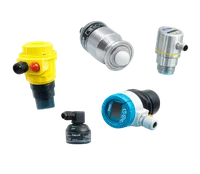
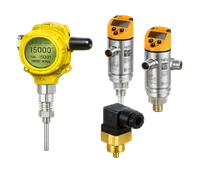
The modular transmitter guided wave radar level sensor is an advanced solution for accurate and continuous liquid level monitoring in industrial environments. Using guided wave radar technology, it measures levels with electromagnetic pulses in nanoseconds, ensuring high precision even in challenging conditions. This sensor is ideal for monitoring aqueous liquids, oils, coolants, and cleaning solutions in tanks and containers of varying sizes.
Key Features
This modular level transmitter offers flexible configurations, including two or four switching outputs or analogue output options. The intuitive interface, combined with a clear LED display, allows users to easily monitor and configure settings. Its adjustable probe length (up to 160 cm) enables seamless adaptation to different tank heights, reducing installation complexity and enhancing usability.
Application
The sensor is widely used in industrial manufacturing, chemical processing, coolant systems, and fluid storage applications. It ensures consistent level measurement in tanks containing oils, water-based liquids, and cleaning agents. Its adaptability makes it suitable for both small containers and large industrial tanks.
Design & Functionality
Built with a robust modular design, the sensor is directly mounted using process connections or flange plates. The guided wave radar principle ensures stable performance regardless of liquid properties such as density or conductivity. Parameter setup, switch point programming, and real-time level indication are easily managed through onboard buttons and display.
Total Crossed Beams
The guided electromagnetic pulses travel along the probe, ensuring precise level detection without interference. This design minimizes signal loss and enhances measurement accuracy across different liquid types.
Beam Pitch Options
The sensor adapts to varying tank geometries through adjustable probe configurations. This flexibility allows optimized measurement performance regardless of container dimensions.
Intrinsic Synchronism
The system ensures synchronized signal processing, maintaining consistent accuracy even during fluctuating conditions or rapid level changes.
Operational Advantages
With IO-Link compatibility, the sensor enables advanced configuration, data visualization, and parameter management through software tools. It reduces manual intervention, improves process reliability, and enhances operational efficiency. Its modular construction ensures easy maintenance and long-term performance in industrial applications.