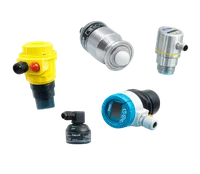
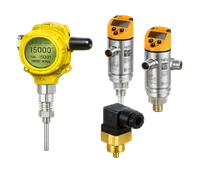
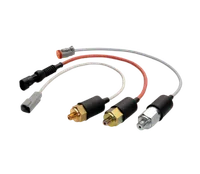
Radar wave level sensors are advanced industrial instruments designed for accurate, continuous level measurement in tanks, silos, and storage vessels. By using high-frequency radar signals, these sensors detect the distance between the sensor and the surface of liquids or solids. This non-contact measurement technology ensures reliable operation in challenging industrial environments where temperature, pressure, vapor, or dust may affect conventional sensors.
These sensors are widely used in process automation, industrial manufacturing, and storage monitoring systems. Their ability to provide stable, high-precision measurements makes them an ideal solution for industries such as chemical processing, water treatment, food manufacturing, oil storage, and bulk material handling.
Key Features
Radar wave level sensors provide highly reliable measurement performance and robust operation in demanding industrial applications.
Key features include:
- Non-contact radar measurement technology
- Continuous level monitoring for liquids and solids
- Wide measuring range for large industrial tanks
- High accuracy with resolution below 0.1%
- Stable operation under temperature and pressure fluctuations
- Support for industrial communication protocols
- Reliable performance in dusty or vapor-filled environments
These features allow industries to maintain accurate process control and improve operational efficiency.
Design & Functionality
Radar level sensors transmit microwave signals toward the surface of the measured medium. When the radar waves reflect from the material surface, the sensor calculates the distance based on signal travel time.
This advanced measurement principle ensures reliable level detection regardless of environmental conditions such as humidity, vapor, or foam.
The sensors are typically installed at the top of tanks or storage vessels, allowing continuous monitoring without direct contact with the medium. This design significantly reduces maintenance and improves sensor longevity.
Total Crossed Beams
The radar sensor uses focused electromagnetic waves that travel directly toward the target surface. These signals ensure precise reflection detection and stable measurement performance across wide storage tanks and tall silos.
The signal processing system filters noise and unwanted reflections, enabling accurate level detection even in complex tank structures.
Beam Pitch Options
Radar wave level sensors offer multiple beam angle configurations to suit different tank geometries. Narrow beam angles are ideal for tall and narrow tanks, while wider beams support open storage tanks and silos.
This flexibility allows the sensor to adapt to various industrial measurement scenarios while maintaining measurement stability.
Intrinsic Synchronism
Advanced radar sensors incorporate signal synchronization and intelligent echo processing algorithms. These features allow the sensor to distinguish between true level signals and interference caused by tank structures, agitators, or pipelines.
This intrinsic synchronism ensures reliable readings in complex industrial installations.
Operational Advantages
Radar wave level sensors offer several operational benefits for industrial process monitoring:
- Long measuring range up to large storage tanks
- Reliable measurement in harsh environments
- Minimal maintenance due to non-contact design
- Accurate monitoring for process control systems
- Suitable for liquids, powders, and bulk materials
With their precision measurement capabilities and robust design, radar wave level sensors play a crucial role in modern industrial automation and storage management systems.