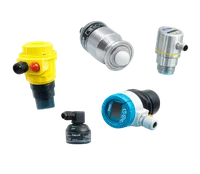
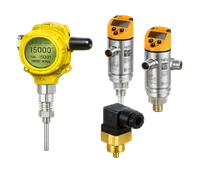
Ultrasonic level sensors are advanced industrial instruments designed for precise and reliable non-contact level measurement in tanks, vessels, and process containers. Using ultrasonic wave technology, the sensor transmits sound waves toward the surface of liquids or materials and calculates the level based on the echo return time. This method enables accurate monitoring without physical contact with the medium, making it highly suitable for corrosive liquids, volatile chemicals, and sensitive process environments.
These sensors are widely used in industrial automation, water treatment systems, chemical processing plants, food production facilities, and storage tank monitoring applications. Their ability to maintain stable measurement performance even when environmental conditions change makes them a preferred solution for modern process control.
Key Features
Ultrasonic level sensors offer several advantages that improve operational reliability and measurement accuracy.
- Non-contact continuous level measurement
- Suitable for liquids, powders, and small bulk materials
- Temperature compensation for improved measurement stability
- Dual output capability for monitoring and switching control
- Resistant to process condition variations such as density changes
- High accuracy and fine measurement resolution
- Designed for industrial automation and tank monitoring systems
These features allow engineers and system integrators to implement reliable level monitoring in a wide range of industrial applications.
Design & Functionality
The sensor operates by emitting ultrasonic pulses toward the target material surface. When the sound wave reflects back to the sensor, the internal processor calculates the distance using time-of-flight measurement. This technology allows the device to provide continuous level readings without requiring physical contact with liquids or bulk materials.
Temperature compensation is integrated to automatically adjust for environmental temperature changes that may affect sound wave speed. This ensures stable measurement performance even in fluctuating industrial conditions.
Total Crossed Beams
The ultrasonic signal is transmitted in a controlled beam pattern that focuses the measurement area directly toward the target surface. This design reduces signal interference from tank walls, structural components, or agitators inside the vessel. As a result, the sensor delivers consistent readings even in complex tank geometries.
Beam Pitch Options
Different sensing configurations are available to accommodate various tank sizes and measurement requirements. Standard models provide a longer measurement range suitable for large tanks, while compact versions are designed for smaller containers and compact installations.
This flexibility allows system designers to select the appropriate sensing solution for different process environments.
Intrinsic Synchronism
Advanced signal processing ensures synchronized signal transmission and echo detection, improving measurement reliability and minimizing noise interference. This intrinsic synchronism enables the sensor to deliver stable readings even in dynamic industrial environments where vibrations, foam, or surface turbulence may occur.
Operational Advantages
Industrial facilities benefit significantly from implementing ultrasonic level sensors for process monitoring.
Key operational benefits include:
- Reduced maintenance due to non-contact operation
- Reliable measurement in corrosive or volatile environments
- Easy installation in tanks and storage vessels
- Stable performance regardless of material density variations
- Improved process automation and level control accuracy
These advantages make ultrasonic level sensors an efficient solution for modern industrial measurement systems.